



PDF vs EPUB for Medical Textbooks: Which Format Should You Choose?
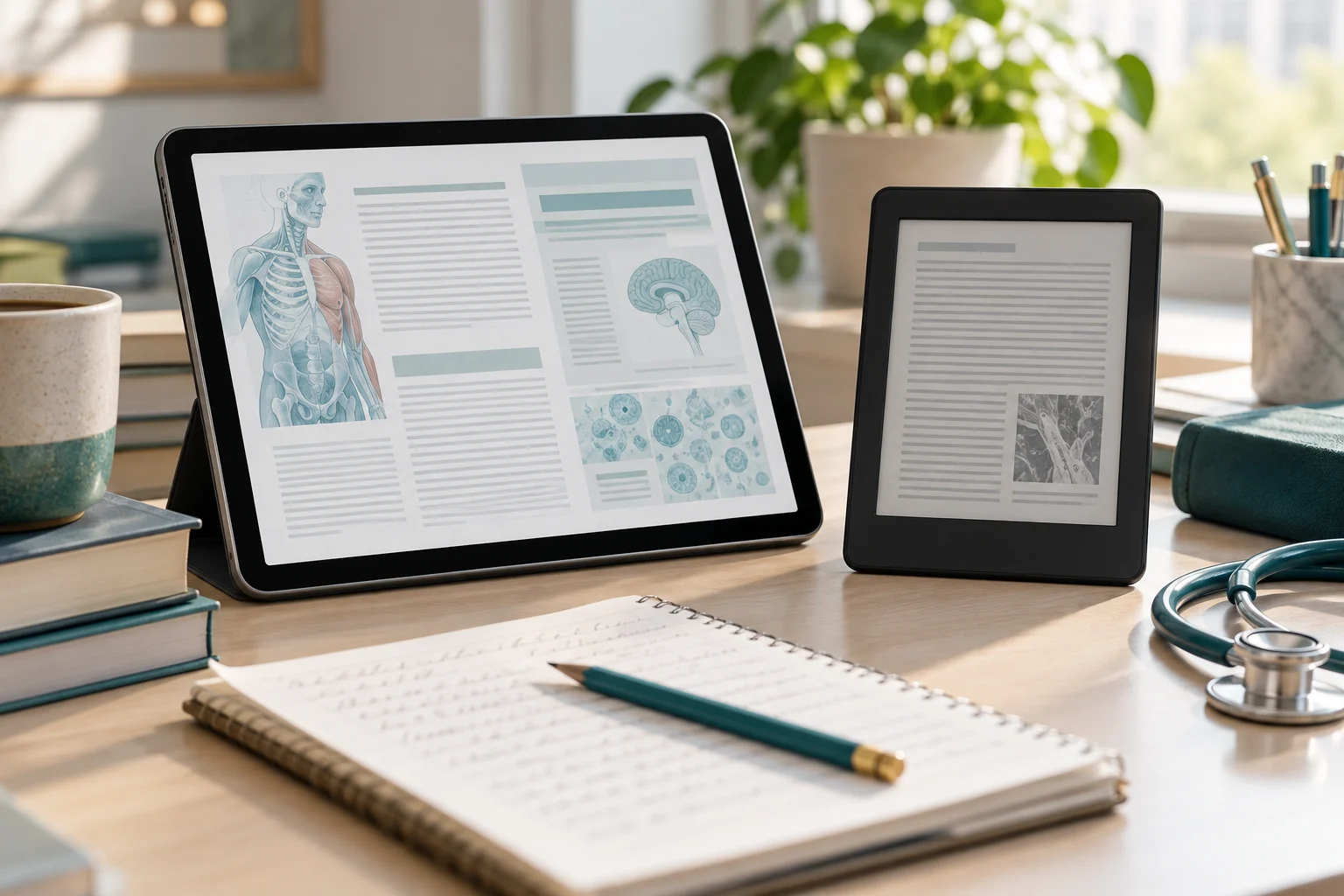
PDF vs EPUB is a real choice when you buy a digital medical textbook: the file format affects how you will study with it every day. The short answer: PDF is usually better for textbooks rich in figures and tables, while EPUB is more comfortable for text-heavy reading on a phone. Here is how to decide.
In this guide
- The key difference: fixed vs reflowable layout
- PDF vs EPUB: side-by-side comparison
- When PDF is the better choice
- When EPUB can make sense
- Choose the format for your device
- Check that the text is searchable
- Accessibility and eye comfort
- The format we use at Digital Med School
- Frequently asked questions
The key difference: fixed vs reflowable layout
A PDF keeps every page exactly as printed: same layout, same page numbers, figures and tables in place. An EPUB (a standard now maintained by the W3C) is reflowable: text adapts to your screen size and font settings, like a web page.
For a novel, reflowable text is ideal. For a medical textbook full of diagrams, ECG tracings, histology images and multi-column tables, it can be a problem: tables may split, and images may move away from the text that explains them.
PDF vs EPUB: side-by-side comparison
| Criterion | EPUB | |
|---|---|---|
| Layout | Identical to print | Adapts to screen |
| Figures and complex tables | Displayed as designed | Can break or shrink |
| Page numbers matching lectures | Yes | Often not |
| Reading on a small phone | Requires zooming | Comfortable |
| Search | Yes, if the text is selectable | Yes |
| Annotation | Widely supported | Depends on the reading app |
| Best device | Tablet or laptop | Phone or e-reader |
When PDF is the better choice
- Anatomy, histology, radiology and cardiology books, where images carry the information.
- Books with large tables: drug references, laboratory values, differential diagnoses.
- Courses where instructors refer to page numbers.
- Studying on a tablet or laptop with annotations.
Examples where layout matters: Netter’s Cardiology, Mosby’s Manual of Diagnostic and Laboratory Tests and Visual Guide to Neonatal Cardiology.
When EPUB can make sense
- Text-heavy books read mainly on a phone.
- Readers who need larger fonts or specific display settings.
- Short review books with few complex figures.
Choose the format for your device
A tablet of around 10 to 13 inches is the most comfortable way to study PDF textbooks: full pages are readable without constant zooming, and stylus annotation works well. On a phone, use the PDF for quick look-ups, and plan longer reading sessions on a larger screen.
Check that the text is searchable
A good digital textbook lets you search for a term and copy short passages into your notes. Before buying, use the preview to check that pages are clear and readable. A scanned image of a page is much less useful than real text.
Accessibility and eye comfort
If you need large fonts, screen readers or high-contrast settings, EPUB adapts better because text reflows. With a PDF, use a larger screen and your reader app’s zoom, night mode and text-selection tools. For most students, the deciding factor in PDF vs EPUB is simple: if the information is in the figures and tables, keep the original layout.
The format we use at Digital Med School
Our eBooks are delivered as PDF, so figures, tables and page layout stay exactly as in the printed edition. Each product page also includes an online FlipBook preview, so you can check the edition and the quality before buying. Read our medical eBook buyer’s checklist for the other points to verify, or browse the eBook catalogue.
Frequently asked questions
Can I convert a PDF to EPUB?
Conversion tools exist, but medical textbooks rarely convert well: tables and figures often lose their structure. For complex textbooks, keep the original layout.
Which format is better for annotations?
PDF annotation is supported by almost every reader app on every platform, which makes it the safer choice if you study with highlights and notes.
PDF vs EPUB: which is better on a tablet?
On a tablet, PDF usually wins for medical textbooks: full pages are readable, figures stay next to their explanations, and stylus annotation works well.
Is PDF good for nursing textbooks?
Yes, especially for fundamentals, med-surg and pharmacology books with many tables. See our guide to nursing textbooks for students.